Modern watchmaking: where miniaturisation, precision, colouration and more are connected by the thread of mechanical ingenuity. What was previously a multi-ton clock tower has been reduced to the size of a wristwatch, while achieving unheard-of levels of accuracy and the unseen vastness of chromatics have become the norm. Such is the unrelenting pace of innovation and technological advancement that new possibilities are unlocked year after year. Today, a watchmaker’s challenge is no longer about making watches that tell time but about mastering timekeeping in increasingly ingenious ways. More often than not, the most remarkable feats emerge from constraints. Thinking outside the box is one of the most accurate expressions, but the real challenge manifests itself when the box (watch case) is roughly 42mm wide and 13mm deep. Based on these limitations, where dimensions are measured in millimetres, tolerances often result in minuscule fractions invisible to the naked eye. These examples serve as a reminder that the greatest marvels in engineering are not always the largest.
Pursuit of Accuracy
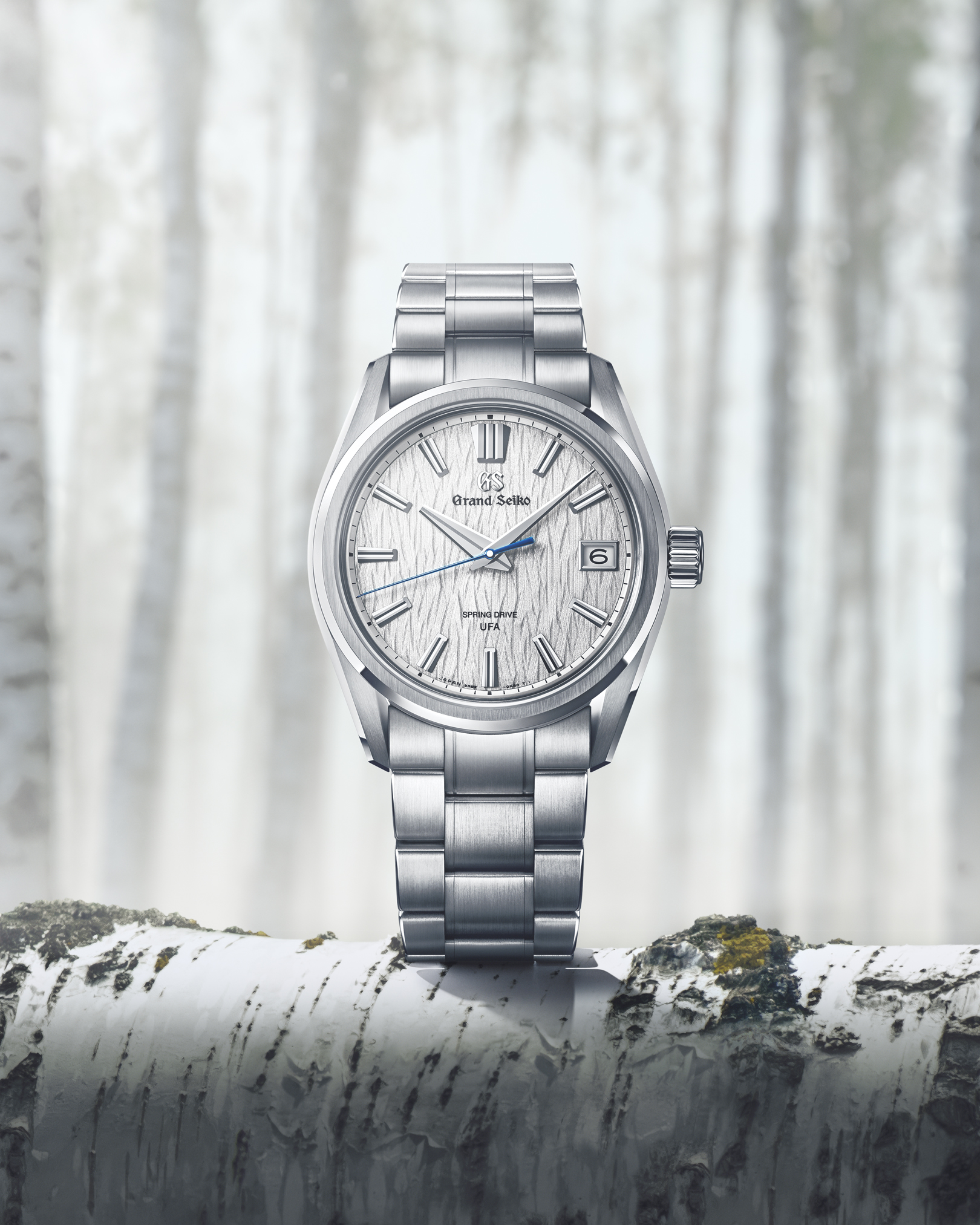
Grand Seiko’s pursuit of accuracy, alongside its naturalist aspirations, sees the Japanese watchmaker iterate on its inimitable Spring Drive movement to the highest order with the Spring Drive Calibre 9RB2. Grand Seiko’s Spring Drive takes the best from mechanical and quartz movements by combining the high torque of a traditional mechanical mainspring with the incredible precision of a quartz oscillator. Doing so allowed Grand Seiko to achieve accuracy deviations of ±20 seconds annually with the Calibre 9RB2’s Ultra Fine Accuracy (U.F.A.) designation, while most watchmakers regulate accuracy deviations of ±3 seconds daily. Much of the improvement to the Spring Drive general blueprint was incremental rather than revolutionary, allowing for this milestone in accuracy to be achieved. Its quartz oscillator was aged for three months to accompany a newly designed IC. Both the oscillator and sensor are vacuum-sealed to minimise temperature fluctuations and protect against humidity, static, and light, ensuring a stable environment for the components. What is new, however, and a first for any Spring Drive movement, is a regulation switch to correct deviations during after-sales service.
Space Bound
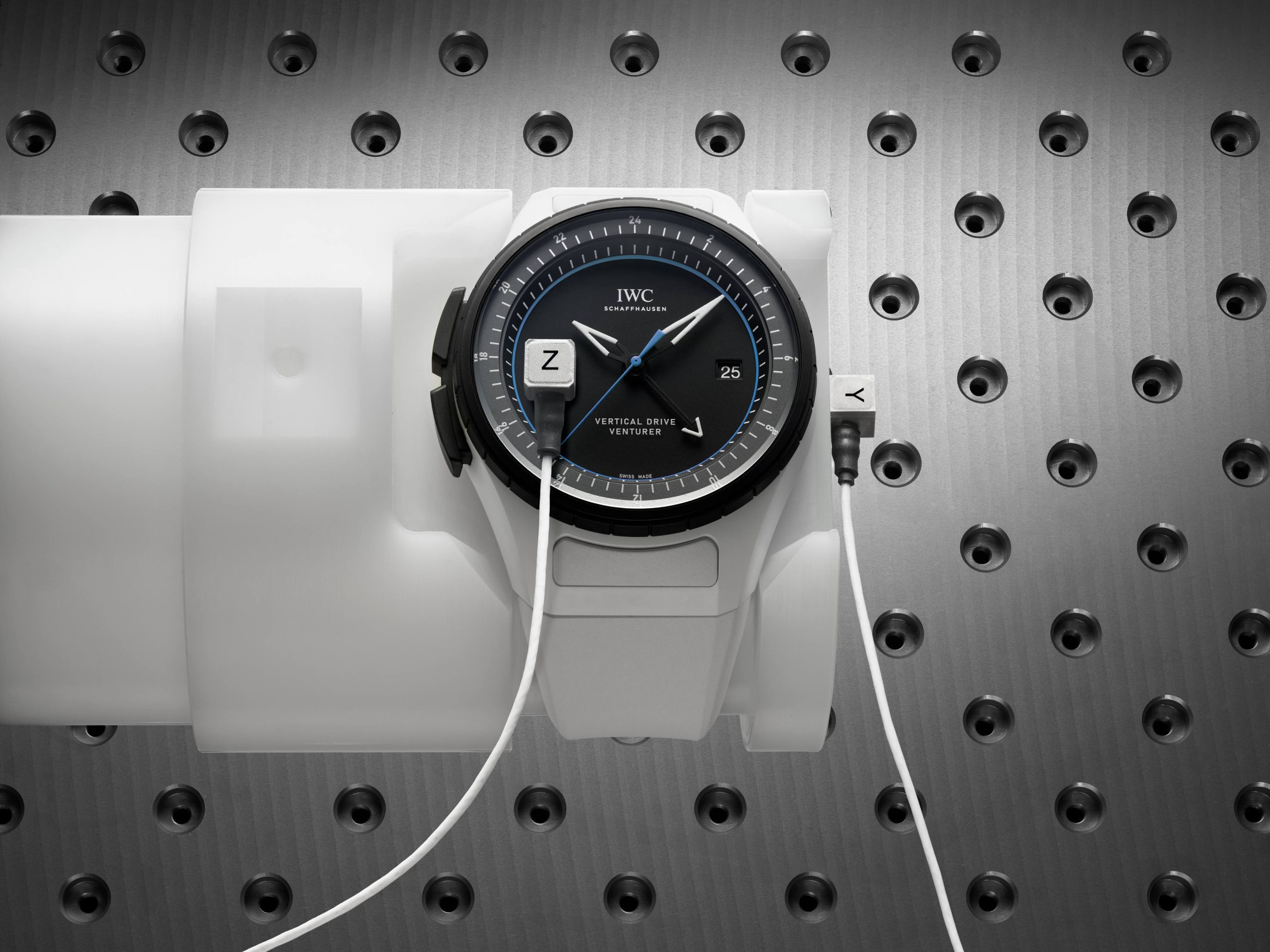
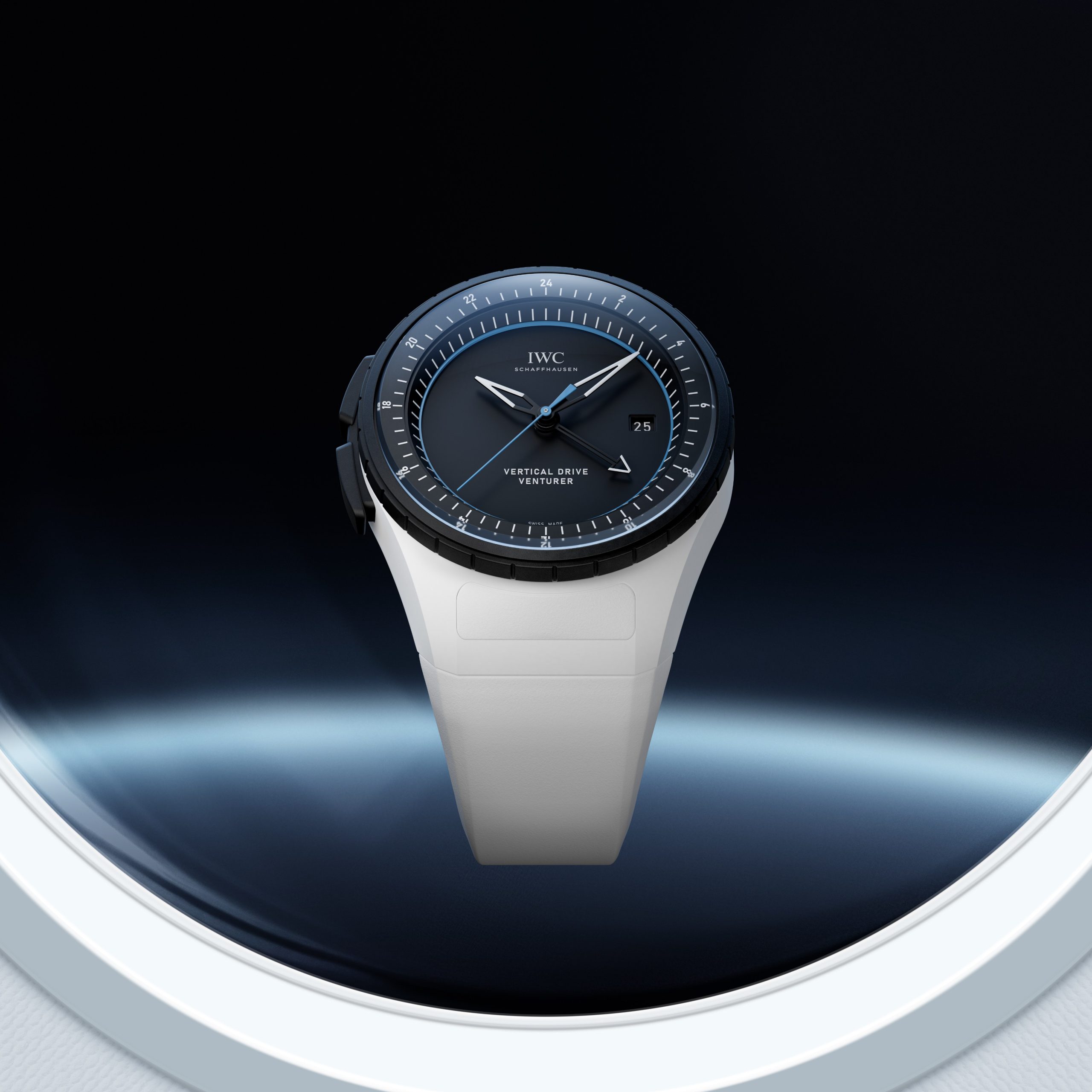
This year, IWC Schaffhausen unveiled the Pilot’s Venturer Vertical Drive, its space-ready creation that meets the unique demands of human spaceflight and timekeeping in space. The next-generation watch, specifically designed in partnership with Vast, signals a forward-looking intent that is underscored by a groundbreaking space certification. Part of the Pilot’s Venturer Vertical Drive’s ingenuity lies in its patent-pending “Vertical Drive” clutch system, which forms the watch’s namesake. This enabled IWC’s engineers to design a rotating bezel system and a side rocker switch that manages the watch’s winding and time-setting functions. Given the harshness of space and travel-related conditions, the Pilot’s Venturer Vertical Drive has been engineered with advanced performance materials. Its case is made from zirconium oxide ceramic, while its rotating bezel and case back are crafted from IWC’s proprietary Ceratanium®. As the name suggests, Ceratanium® combines the best of ceramic (scratch resistance) and titanium (lightness and structural integrity). To ensure reliability and robustness for mission confidence, the Pilot’s Venturer Vertical Drive has been extensively and rigorously tested by Vast before attaining spaceflight qualification and certification for the Haven-1 mission. Haven-1 is set to be the world’s first commercial space station and will pave the way for the multi-module, continuously crewed Haven-2 station that is the proposed successor to the International Space Station (ISS).
Rare Metals
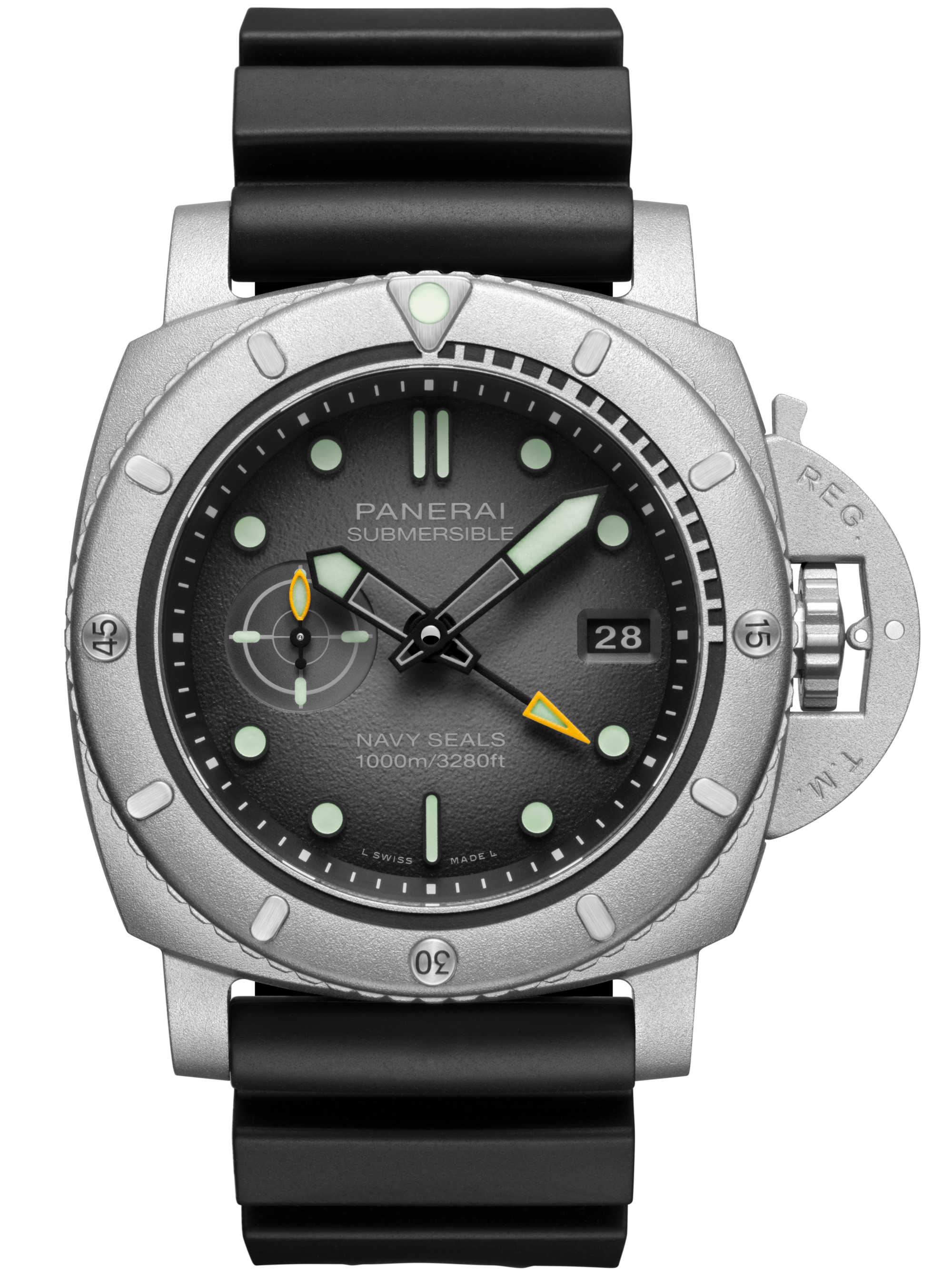
Within the arena of tool watches, Panerai’s latest experiment has elevated its status as one of the undisputed kings of material innovation. Its latest foray into the periodic table sees Panerai working with hafnium for the Submersible Navy SEALs Afniotech™ Experience PAM01089. Because of its extreme density, heat resistance, and corrosion resistance, hafnium is typically used in nuclear control rods and aerospace applications. Given that the rare material is always bound to zirconium and that their atomic sizes are nearly identical, separating hafnium is chemically difficult and expensive. Machining hafnium poses another challenge as specialised tools, extended production time and constant supervision are required. Panerai, however, spotted an affinity between hafnium and the Navy SEALs, who share similar unbreakable and immovable values to hafnium. The resulting watch is a symbol of extreme resilience, rated to 1000m water resistance among its other virtually indestructible properties. The watch is limited to 35 pieces and allows its owners to embark on a unique three-day Special Operations Experience with the Navy SEAL scheduled for March 2027.
Techniques d’Avant Garde
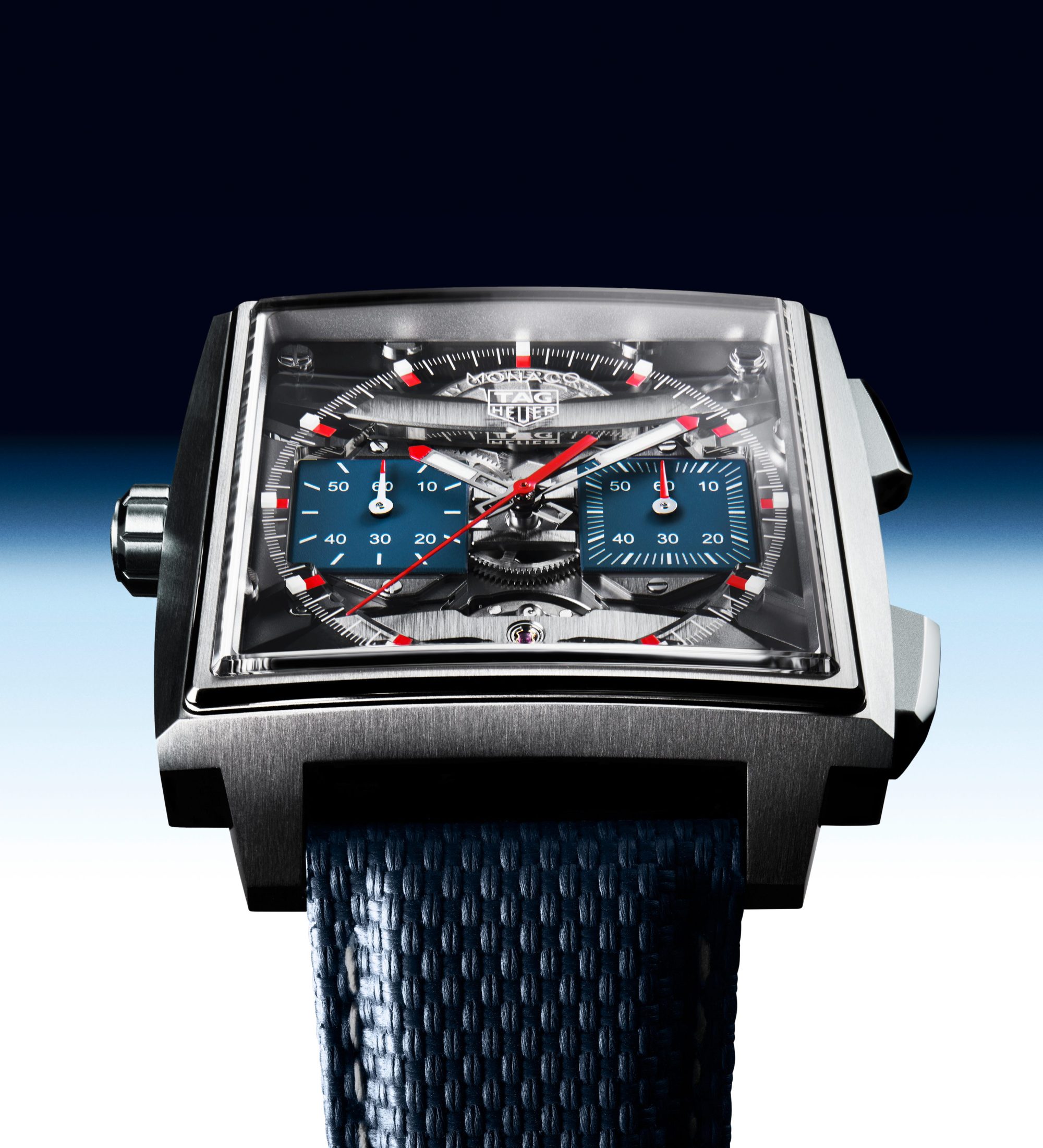
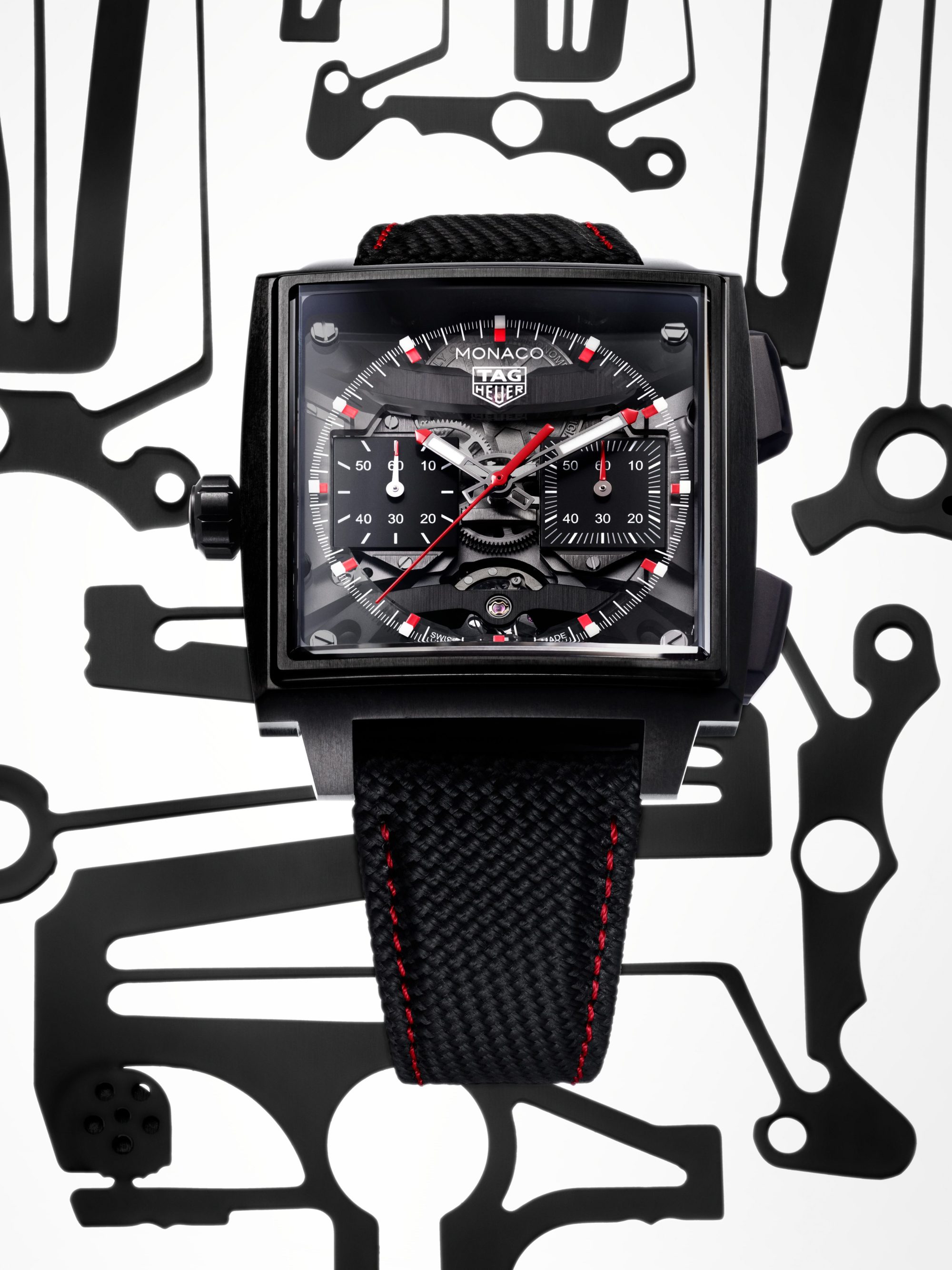
For decades, watchmakers relied on traditional cam-and-lever or column wheel chronograph driving mechanisms. That was until TAG Heuer flipped the script and reminded the watchmaking world of its serious chronograph-making capabilities with the launch of the Monaco Evergraph. After five years of development alongside Vaucher Manufacture Fleurier, the Swiss watchmaker introduced the revolutionary compliant chronograph mechanism developed in-house by the TAG Heuer LAB. The Calibre TH80-00 removes traditional levers and springs used for chronograph start, stop, and reset functions and replaces them with two flexible bistable components: one governing start and stop, the other reset. The elastic qualities of the LIGA technology components allow for deformation to engage the chronograph commands. As such, any potential failures caused by the traditional chronograph’s mechanical engagements are virtually eliminated. Of TAG Heuer’s stacked family, the Monaco was the natural choice to be fitted with this revolutionary calibre, given its role in reshaping watchmaking codes when it was unveiled in 1969. The Monaco Evergraph is housed in a 40mm grade 5 titanium case with an open dial that reveals the movement.
Since 2021, the poetic lore of automata has been a creative exponent of La Fabrique du Temps Louis Vuitton.This year, the manufacture taps into grand feu enamel to present a medley of colours and movement in theTambour Taiko Arty Automata. At the heart of the watch is the Calibre LFT AU05.01, whose 363 componentsare artfully dedicated to the main gear that controls time, a dedicated gear system to drive the seven automatonanimations, a trigger and the governor, which controls the automaton speed. On activation, four Monogram Flowerstwirl in alternating fashion while the candy heart rocks to and fro. Simultaneously, a diamond-set “L” beside thetourbillon swings over to reveal the hidden “M” beneath to declare “LOVE” and “MOVE”. The narrative of movementcontinues in the enamelled elements, as successive applications and kiln firing over 250 hours enrich the 23 pastelcolours, from patchy and dull to rich and lustrous. Given the technicolour on display, a rainbow spectrum of baguette-cut rubies and sapphires that reflect the enamel colour palette are set into the 42mm 18k white gold case.
Grand Automata
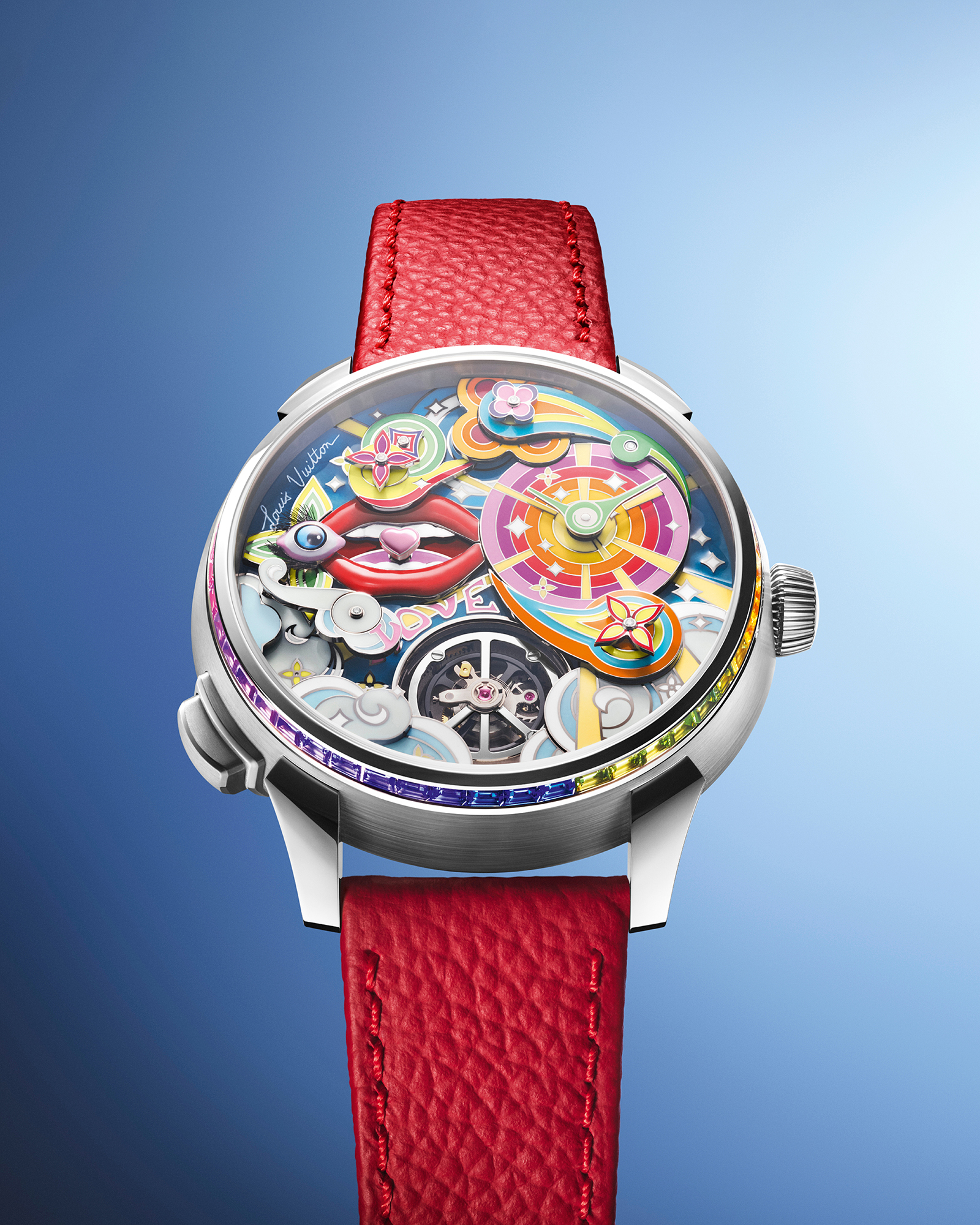
Since 2021, the poetic lore of automata has been a creative exponent of La Fabrique du Temps Louis Vuitton. This year, the manufacture taps into grand feu enamel to present a medley of colours and movement in the Tambour Taiko Arty Automata. At the heart of the watch is the Calibre LFT AU05.01, whose 363 components are artfully dedicated to the main gear that controls time, a dedicated gear system to drive the seven automaton animations, a trigger and the governor, which controls the automaton speed. On activation, four Monogram Flowers twirl in alternating fashion while the candy heart rocks to and fro. Simultaneously, a diamond-set “L” beside the tourbillon swings over to reveal the hidden “M” beneath to declare “LOVE” and “MOVE”. The narrative of movement continues in the enamelled elements, as successive applications and kiln firing over 250 hours enrich the 23 pastel colours, from patchy and dull to rich and lustrous. Given the technicolour on display, a rainbow spectrum of baguette-cut rubies and sapphires that reflect the enamel colour palette are set into the 42mm 18k white gold case.

Colour Science
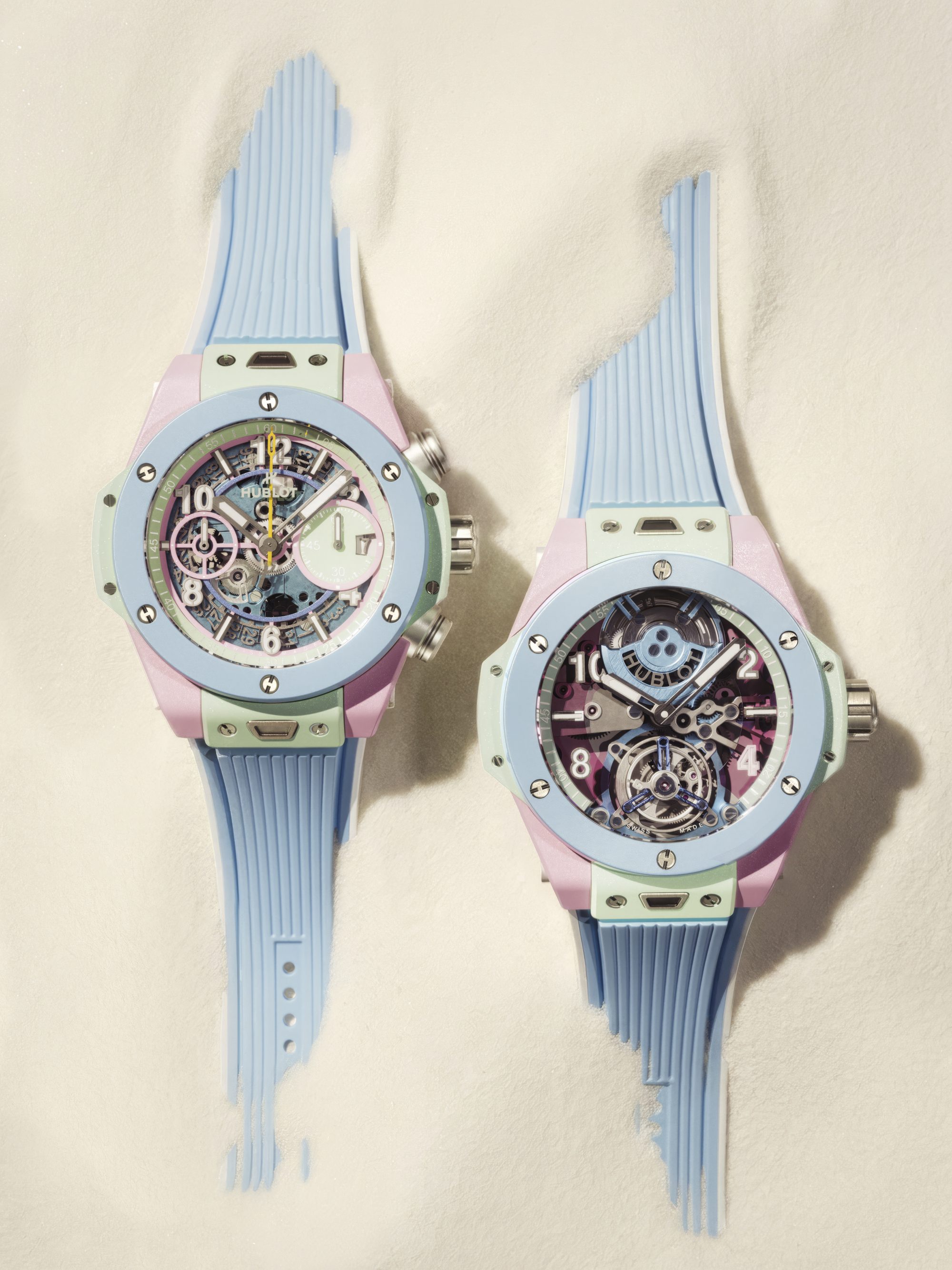
Ceramic was and continues to be one of the most important innovations in modern-day watchmaking. Prior to the proliferation of the material in today’s market, only a handful of watchmakers could lay claim to be masters of the material. In the mid-2000s, Hublot’s introduction to the material marked its first steps down what would eventually be a rabbit hole of ceramic development. Beyond crafting ceramic components, Hublot championed coloured ceramics in 2018 after years of intense R&D that added greater complexity to ceramics’ already complicated manufacturing process. Metallic oxide pigments responsible for imparting colours often burn during the sintering process, resulting in high failure rates during intensive experimentation periods. After adding vivid colours to its achievable repertoire of palettes, Hublot showcased its mastery by introducing the two Big Bang Summer models. Three dominant pastel shades of mint, pink and sky blue come together to evoke the summery sensation of the Mediterranean.
Lux Lumen
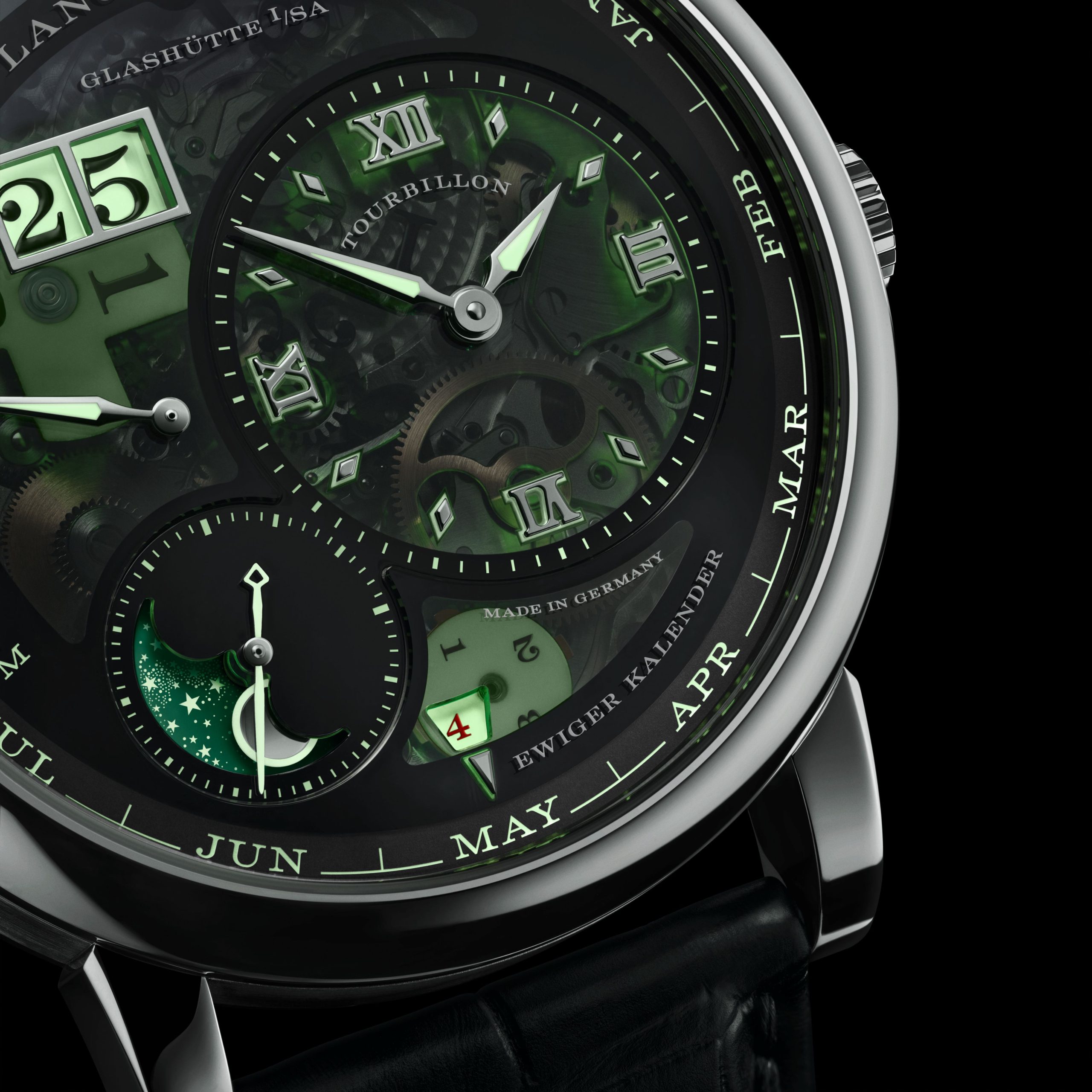
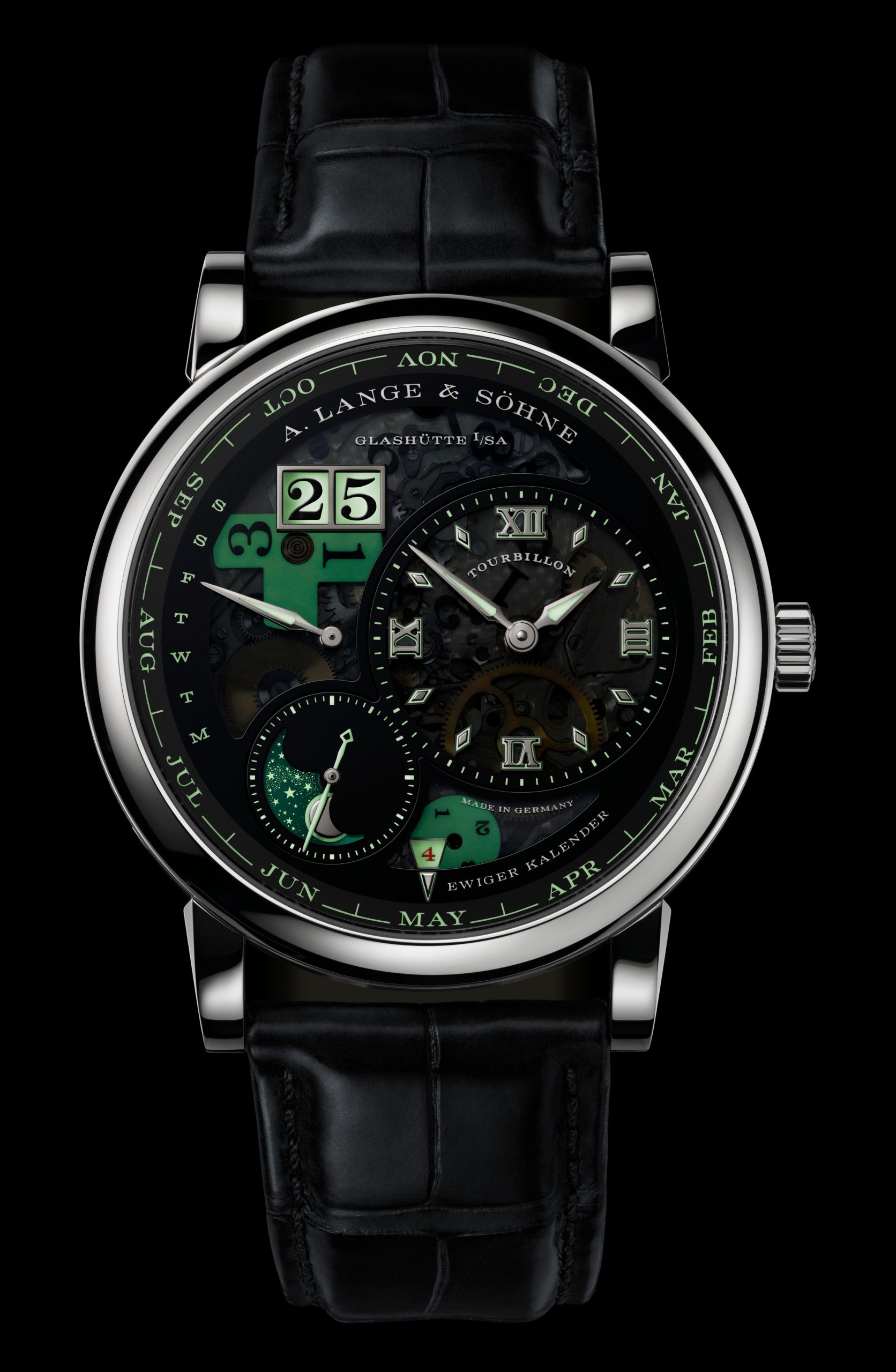
Giants of Saxon watchmaking, A. Lange & Söhne, unveiled its glanzstück at Watches & Wonders 2026: the Lange 1 Tourbillon Perpetual Calendar “Lumen”. The masterpiece unites the namesake tourbillon and perpetual calendar complications in a platinum case. Instead of conforming to visually classical codes, the “Lumen” application is a modernist take on nighttime readability. The time-telling and perpetual calendar elements are treated with luminescent material. A darkened, semi-transparent dial allows energy-rich UV light to pass through the luminous compound beneath the displays, which in turn causes them to glow in the dark. The Lange 1 Tourbillon Perpetual Calendar “Lumen” is powered by the self-winding manufacture calibre L225.1 and is limited to 50 pieces.
Mechanical Levity
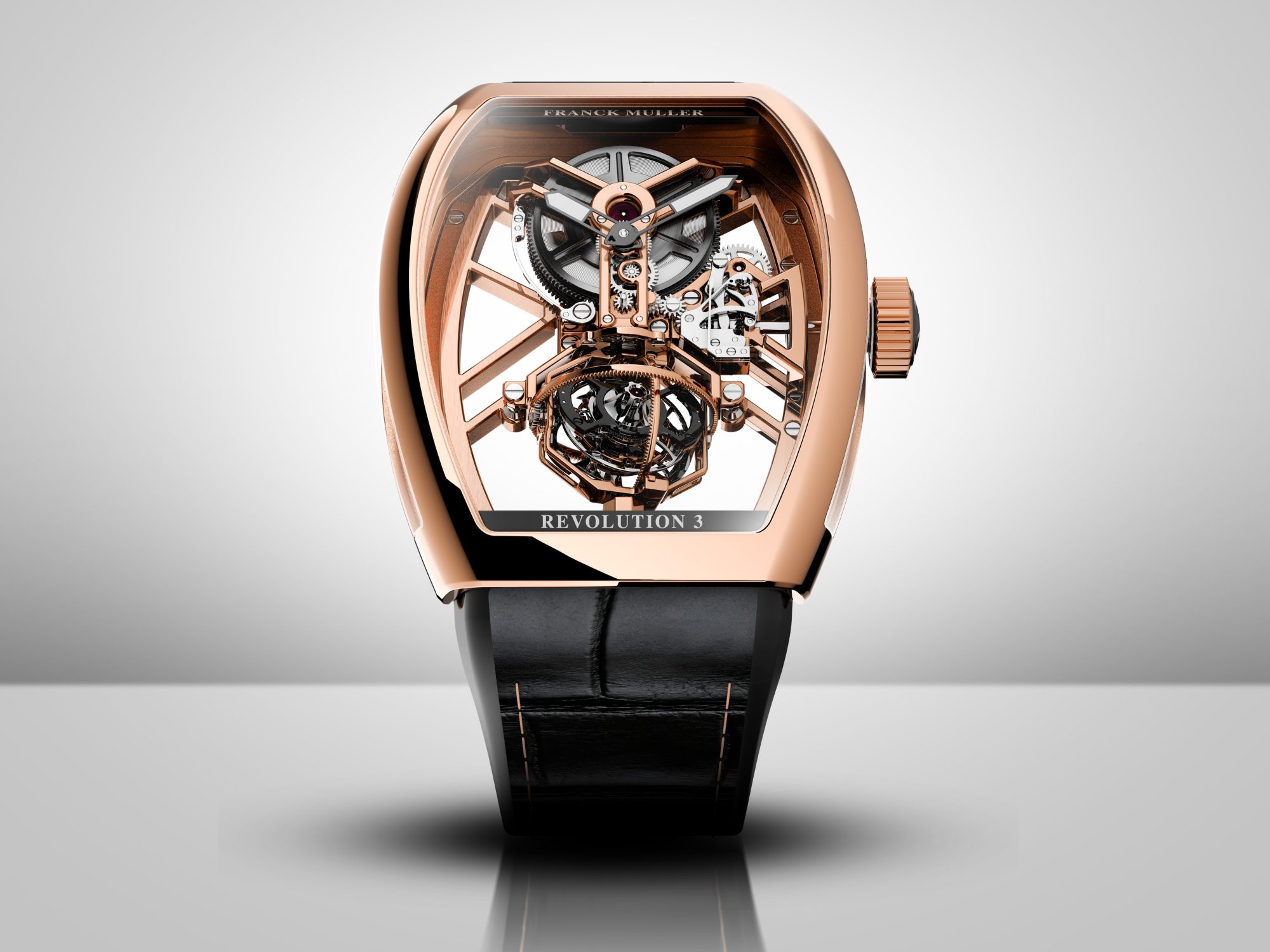
Although maximalism is often synonymous with Franck Muller, the Swiss watchmaker presents an alternate, less-is-more take on the Vanguard Aero Revolution 3 Skeleton. Here, mechanical ingenuity comes to the fore. Instead of spreading all 280 components as a conventional movement would, the MVT FM 2031-VS was mounted directly onto the caseback and reconfigured alongside the cavernous case construction. The resulting airiness contributes to the watch’s Aero moniker. Conversely, the other bit of the watch’s namesake lies in the pièce de résistance tri-axial tourbillon. Three concentric cages rotate on different axes and rates to completely negate the effects of gravity on the watch’s beating heart. The innermost completes a rotation every 60 seconds, the intermediate cage every eight minutes, and the outer cage every hour. Case openings on either side of the tonneau case offer a layered view to the Vanguard Aero Revolution 3 Skeleton’s inner workings.
Once you are done with this story, click here to catch up with our latest issue.