There have been noticeable shifts in global culture. Each year feels like it is worse than the last. Sure, you could say I am being bleak, but there is no denying that the world has spiralled, deepening our collective cynicism. About 30 years ago, political scientist Francis Fukuyama coined the concept “the end of history”, in which he argued that Western liberalism was the final form of human government, as opposed to communism. He wrote it with the belief that liberal capitalist democracy was the strongest and most stable system left after the fall of the Berlin Wall. Thirty years later, that system has faltered. Instead of “the end of history,” the past three decades have exposed liberal democracy’s weaknesses: rising authoritarianism, institutional erosion, and a global order that is increasingly shaped by fragmented identities and technological upheaval.
Day after day, what shows up on news feeds is a relentless stream of reports on atrocities, plague, death, starvation and disaster. Humanity is now seeing these events unfold in real time as a collective experience. For the first time in history, violence and suffering are livestreamed, posted, reposted, shared, and consumed within seconds of their actual occurrence, thanks to the immediacy and accessibility of social media platforms like TikTok. Ditto for the arena of global politics.
Since Donald Trump began campaigning for a second term and after being inaugurated as the 47th President of the United States earlier this year, he has used the Internet to legitimise a spectrum of extremist far- right factions. These range from neo-Nazis to white supremacists, tech billionaires, Christian nationalists, and fascists. The game of politics in this day and age is thus no longer driven by a singular frontman spewing stirring speeches, but a complex, herculean online operation to manipulate, sway and convince people who have increasingly short memory and attention spans to vote for them, sympathise with them, victimise themselves even, and more crucially, promote partisan narratives that benefit only them.
This broad, decentralised form of information, or rather, misinformation dissemination through the Internet by these extremist groups are part of the reason why there has been a stark shift towards conservatism, especially among Gen Z. Fascist dog whistles and rhetoric can be found everywhere, under a veiled sheet of innocence. You might even find yourself agreeing with them such as returning to “traditional” values, or the recent American Eagle ad tagline “Sydney Sweeney Has Great Genes Jeans”. Such rhetoric is easy to fall into, and fascists take full advantage of our inability to focus on the Internet, given that our contemporary culture is already exploding with extreme overload. On the Internet, everyone fights not just for our attention, but also for our morals and ethics. And, surprise, we cannot juggle it all.
Cultural critic Shumon Basar calls this “The Extreme Self”: a state where the Internet pushes us to react instantly and constantly, leaving us more exposed to simple, persuasive messages, including extremist ideas. This brings us to our discussion today: if everything can be coded and persuasive, so can fashion.
In recent seasons, Miuccia Prada and Raf Simons have acknowledged this rising phenomenon. And with their cultural influence in shaping taste, aesthetics, and public sensibilities, their work signals a quieter, more hopeful force that feels especially necessary now.
These days, with fashion journalism; specifically, online fashion journalism, as fashion commentator Louis Pisano puts it, “stopped being about cut, fabric, or silhouette and became a kind of emotional cosplay where instead of reviewing the clothes, you projected onto them. Every collection had to be a metaphor for something bigger: climate grief, late capitalism, your third situationship of the year.”
With Prada, every collection is dressed as food for thought; in fact, it is one of the only shows of the season where you can philosophise without looking like you tried too hard to please your title sponsors. Unlike many houses, Prada functions as a sounding board for the present, reflecting the cultural and ideological tensions of the moment. Some seasons are gentler; others are starkly confrontational. This year, Prada moves full force to address the conditions of our era.
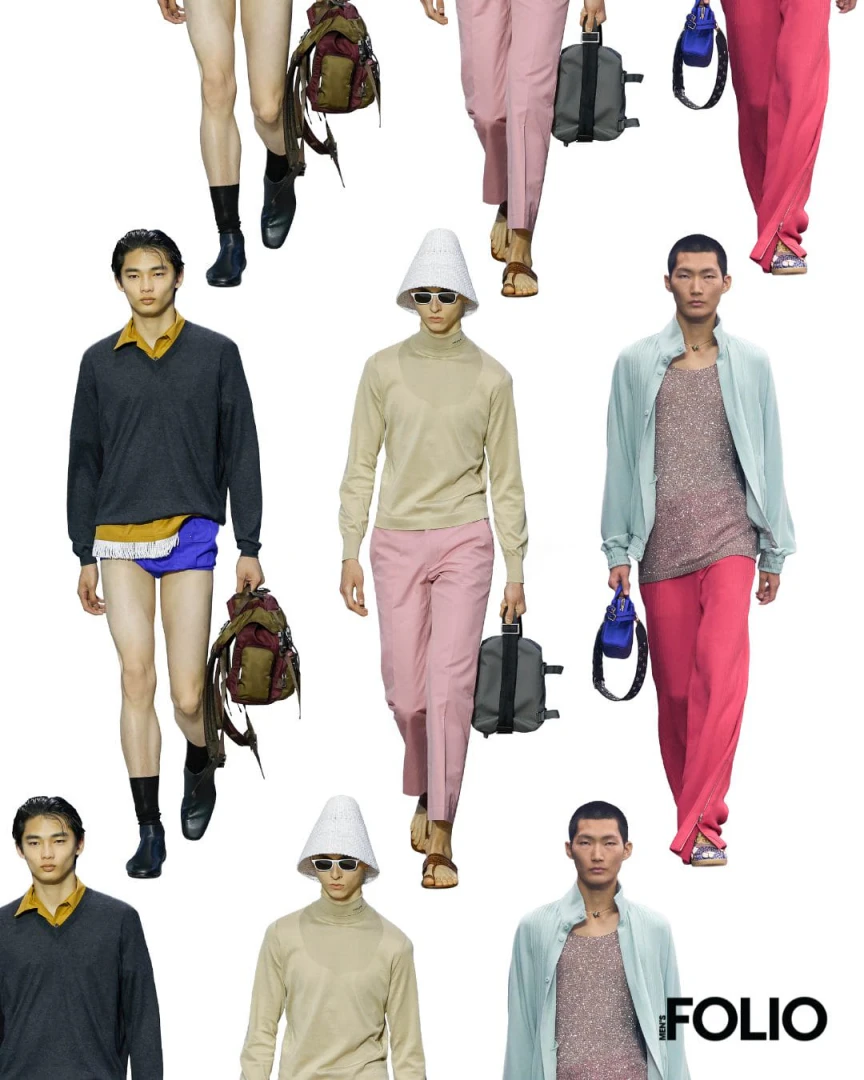
Prada’s Spring Summer 2026 season, titled “A Change Of Tone” for men’s and “Body of Composition” for women’s, states its intentions as “a response to the overload of contemporary culture.” The clothes are reflective of that statement. The house’s design framework this year is the deconstruction of methods of dress and the dismantling of hierarchies — particularly those long embedded in conventional wardrobe archetypes and the rules that govern them.
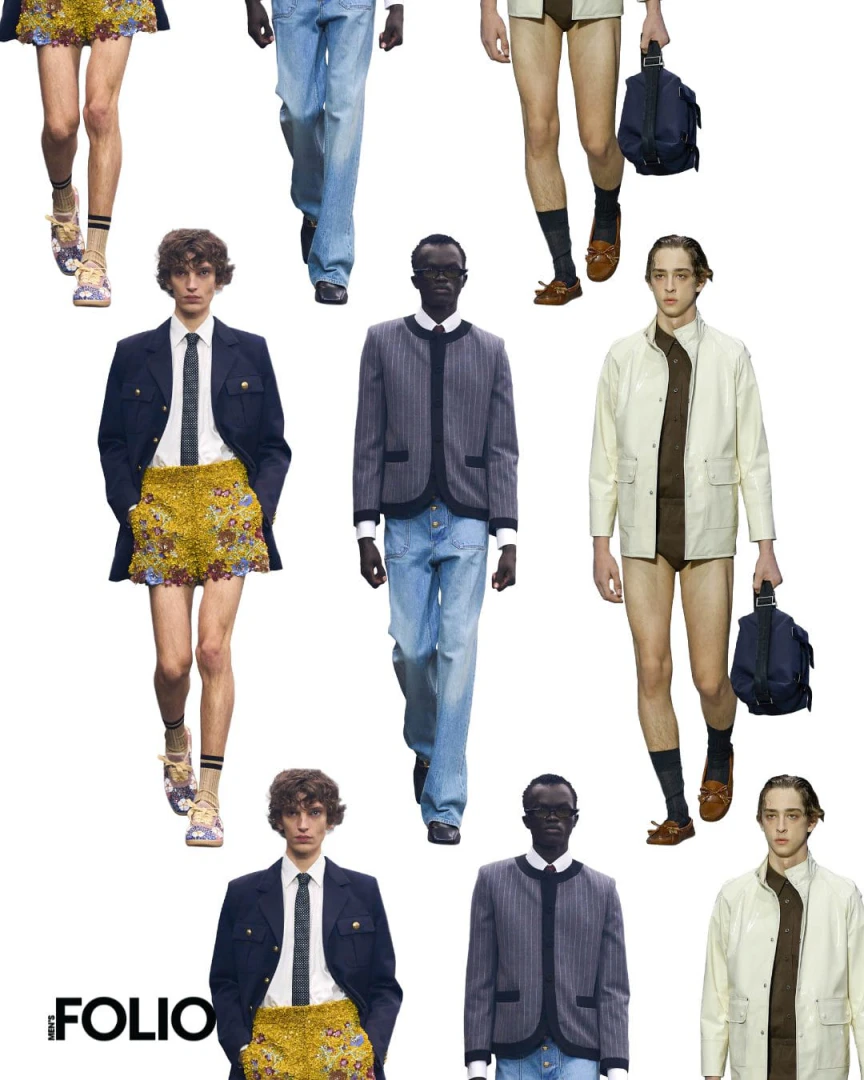
Bright red jogger leggings are worn with a black blazer. A crisp brown military shirt is paired with matching hot shorts. Floral sweaters are worn with just underwear and sandals. Windswept straw hats look like lampshades. A pinstripe shirt shifts into a dress. For the ladies, that tense confrontation gets dialled up. The uniform, revered by both Raf Simons and Miuccia Prada in their long careers, gets a reshuffle again. Unstructured brassieres are paired with skirts that rest not on the hips but on the shoulders. Safari sets are paired with opera gloves in soft pastel colours. The swing dress, a silhouette once popular in the 1950s, when many women started to return to traditional domestic roles after World War 2, gets recontextualised with military epaulettes. Clothes are “Frankensteined” with different textures and cuts.
A friend described it to me as “an amalgamation of hardship”, where both men and women descend into a wardrobe that is much more androgynous, and even adopt a mutation of gendered dress codes. All of which are direct oppositions to the agendas that right-wing governments are pushing: effeminate men, strong women, simplicity in the backdrop of complexity. If fascist rhetoric relies on rigidity — fixed identities, strict gender roles, and an idealised return to “tradition” — Prada counters it with ambiguity and refusal. Uniformity and conformity, doubt and fear are ammunition used by the right. Prada uses hope.
“We wanted a change of tone. The opposite of aggression, power and nastiness that runs the world now. So we try to make a little contribution with something genuine,” says Miuccia Prada in an interview. “It’s fashion that’s connected inherently to the world, with meaning and usefulness. How to face the world, and how to survive,” she says in another.
With this new rise in political power, some industries have chosen to pander while others have retaliated. Fashion is one of the latter. Apart from Prada, other houses have begun to join the conversation, offering their interpretations of the present. Valentino’s “Fireflies” collection shownotes recalls a story of overcoming fascism 90 years ago, and how, like the passage of human history, it can be overcome again. Hope, this season, is politely scattered across our writings, our design philosophies and methodologies. It is the viewer who must be able to discern and abstract it.
Surely, that pistachio trench coat from Prada will not save you. A bedtime story by Alessandro Michele will not save you from the forces of evil. Nobody is saying that it will. But like art, what matters is what you take out of it. The beauty of fashion is how it speaks to people.
Like the infamous Cerulean monologue from The Devil Wears Prada, the trickle-down effect is in play. “It’s sort of comical how you think that you’ve made a choice that exempts you from the fashion industry when, in fact, you’re wearing the sweater that was selected for you by the people in this room”, says Miranda Priestly to a confused Andy Sachs.
So what if “the people in this room” made a choice aimed toward something better? A message that may not land instantly for everyone, but can move quietly — from designer to editor to consumer — to shape taste, language, and the small decisions that make up our cultural behaviour. If we step back to Shumon Basar’s words, in an age where our identities are constantly shaped by what we see and absorb online, that trickle then becomes more powerful. The same heightened responsiveness that extremists exploit can also make us receptive to softer, more constructive messages. At least, if that is what we are fed.
Watching how it all unfolds is the interesting part. If the most powerful voices in fashion push back against the atmosphere of fear and aggression, how might its audiences shift in how they think, speak, and relate to one another? In a culture where every image and gesture has influence, even small aesthetic choices can tilt the direction of the collective self.
Only time will tell.
Once you are done with this story, click here to catch up with our December/January 2026 issue.