Most connections today do not begin with a message. They begin with recognition. A song chosen for an Instagram story. A reel sent at a very specific moment. A TikTok repost liked when it did not strictly need to be. These gestures appear casual, yet they are often the first signs that attention has shifted from passive viewing to interest.
This is not silence, but it is not conversation either. It exists in a space shaped by observation rather than exchange. People notice what others leave behind online and respond in kind. What once required words now unfolds through timing, repetition, and behaviour.
This way of connecting is not hidden. It plays out publicly, across feeds and timelines that anyone can see. But the meaning is selective. It is understood by the people involved, even if no one else registers it. That selectivity is what gives these gestures their charge.
Social platforms were not designed to carry intimacy, but they have been taught to. Over time, people have learned how to use their structures as a language of their own. The tools meant for broadcasting have been repurposed for signalling, familiarity, and intent.
An Instagram story, for example, is technically a broadcast. Yet when the audience is narrowed, the meaning changes. A Close Friends post becomes directional. The choice of image, music, or timing feels deliberate, even when nothing is stated outright. On platforms like TikTok, the same logic applies. A repost can be passive or purposeful, and when someone likes that repost, the platform confirms exactly who noticed and when. What appears casual becomes legible, turning attention into acknowledgement.
Music, too, has become part of this quiet exchange. Spotify listening activity is checked. Playlists are noticed. What someone plays late at night or loops repeatedly becomes part of how they are read. Wrapped, stat pages, and similarity percentages turn taste into something visible and comparable. Music shifts from private habit to public signal, another way of suggesting alignment or closeness without having to say it directly.
These actions are not messages, but they function like them. They allow people to express interest without committing to language. They create momentum without forcing definition.
Direct communication carries consequence. It asks for clarity and response. It leaves little room to retreat. Indirect gestures, by contrast, offer flexibility. A story can be ignored. A repost can be explained away. A playlist can be coincidence. Subtext provides emotional cover. Interest can be shown without exposure, and withdrawal can happen without explanation.
For a generation raised online, this fluency in subtext is learned early. Tone is inferred through behaviour rather than language. Intent is read through patterns rather than statements. To hint feels more natural than to ask. Indirectness becomes a form of emotional literacy, not avoidance.
This helps explain why signalling often feels considerate rather than evasive. It leaves space for the other person to engage at their own pace. It avoids forcing something into clarity too soon. In an environment where visibility is constant and attention is fragile, subtlety becomes a way of approaching closeness without overwhelming it.
But this fluency comes with a cost. When everything is suggested, nothing is anchored. Connection can build quickly, but it struggles to arrive anywhere concrete. Interest is felt without being confirmed. Familiarity grows without agreement. People circle each other in a shared understanding that never fully settles.
Subtext relies on interpretation, and that is where intimacy enters. When someone understands a gesture without it being explained, it feels affirming. Timing matters. A reaction that arrives immediately carries different weight from one that arrives hours later. Consistency matters more than intensity. Patterns are noticed, remembered, and compared.
Over time, these patterns form a shared literacy. Certain gestures become legible. They are not universal, but they are widely recognised. This shared understanding allows digital intimacy to function without conversation, using cues that feel intuitive rather than formal.
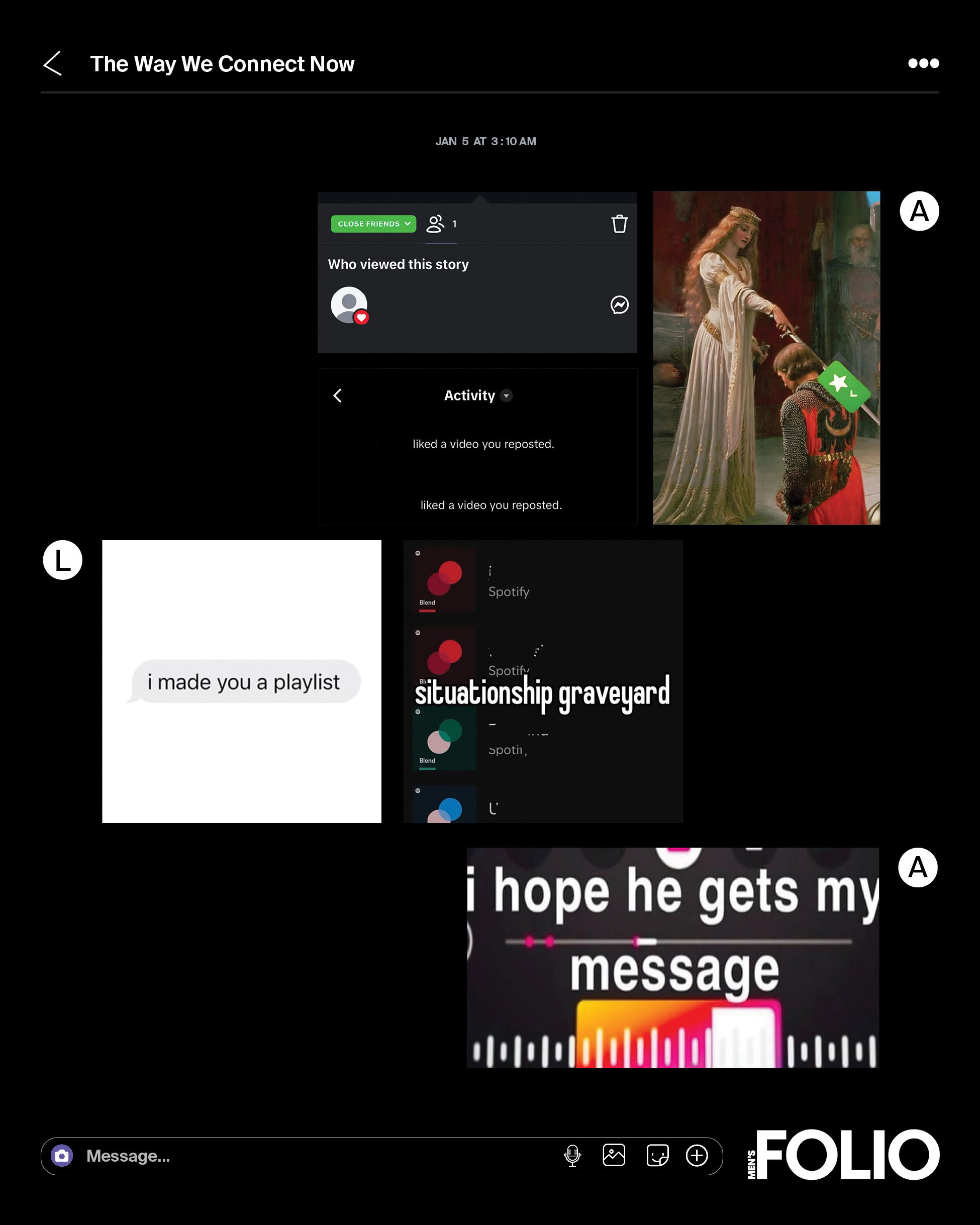
At the same time, the ambiguity that makes subtext appealing also makes it unstable. A playlist can be deeply considered or entirely random. A repost can be directed or purely reflexive. Engagement can signal interest or simply habit. The difference is not always clear, even to the person doing it.
Platforms also collapse distance. A gesture can feel intimate even when the relationship itself is not. Someone can feel close through daily digital contact while remaining largely unknown offline. The connection feels real, but it is built on fragments.
As a result, people often negotiate intimacy without shared reference points. There is no agreed moment where something begins. No clear shift from casual to intentional. Meaning accumulates gradually, spread across many small moments rather than anchored to one decisive exchange. Misalignment becomes easier. Resolution becomes harder.
Yet these behaviours persist because they are shared. Posting something with a specific person in mind. Checking who viewed a story. Noticing when someone stops engaging. Reading into a repost. These actions feel individual, but they are deeply collective. Almost everyone has participated in them, often without consciously naming them.
Naming them outright can feel uncomfortable. Once articulated, they lose some of their subtlety. Subtext depends on remaining unspoken. It works best when it stays just below the surface.
Online platforms are no longer separate from social life. They are environments people move through daily. They shape how relationships form, how they develop, and how they dissolve. The architecture of these platforms influences behaviour. Visibility becomes presence. Silence becomes response. Attention becomes currency.
This does not mean intimacy has disappeared. It has changed form. It has shifted into smaller gestures and quieter exchanges. People are not expressing less. They are expressing differently.
What this reveals is not emotional detachment, but discomfort with clarity. Modern intimacy prioritises signalling over naming, attention over declaration. It allows people to feel close without arriving at definition. It protects against rejection, but it also delays certainty.
By the time something is said directly, much of the emotional groundwork has already been laid. Direct communication still matters, but it often arrives later, once ambiguity has done its work.
This is how people connect now. Through timing. Through repetition. Through intention embedded in ordinary behaviour. Nothing is stated outright, yet meaning accumulates all the same.
In a culture that values ease and low stakes, this form of connection feels natural. It allows people to approach closeness carefully, to care without overexposing themselves, and to retreat without confrontation. Subtext offers comfort, familiarity, and the feeling of being understood without having to ask for it outright.
But signalling can only take a connection so far. When interest is endlessly suggested and never named, intimacy stalls. The risk is not rejection, but remaining suspended in something that feels meaningful without ever becoming real. Modern connection has taught people how to get close without speaking. What it struggles with is knowing when to finally say something.
Once you are done with this story, click here to catch up with our latest issue.